
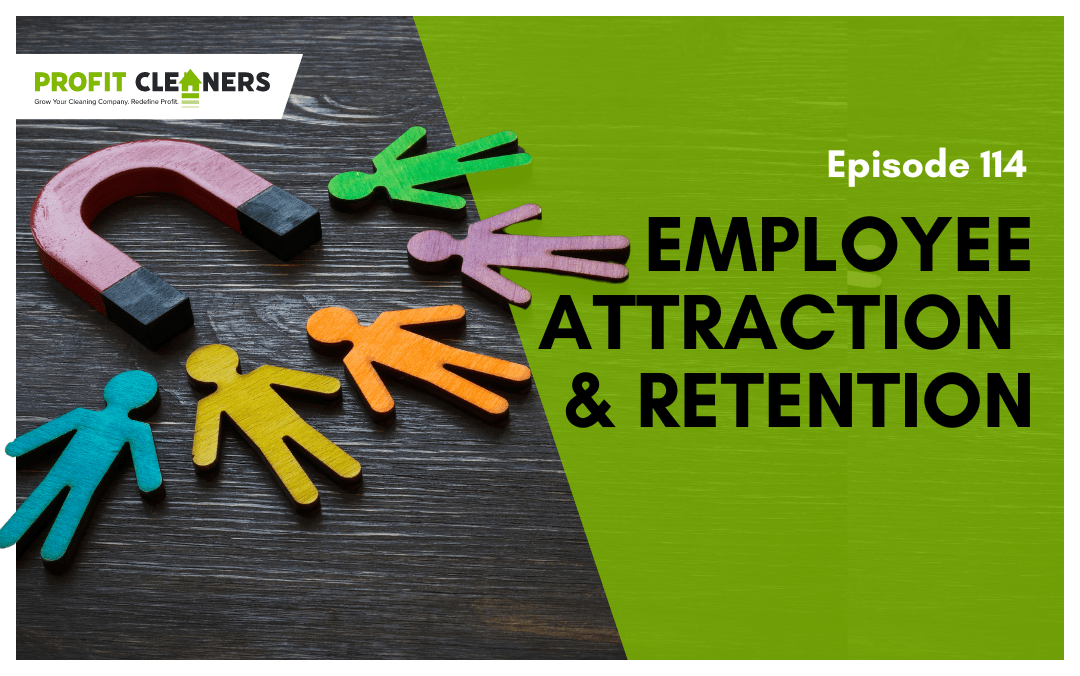
No one needs to tell you how important employees are in the cleaning industry – you already know. The foundation of a strong and long-running company, employees will make or break your business over and over again. When you find employees who are capable, committed, and skilled, you have to do everything you can to hold on because they’re one of your biggest assets.
In this second part of their interview with Kerri Anne Keziora, CEO of KAP Cleaners, the Brandons dive into a discussion about employee retention and how treating employees well can increase profits in your business. Kerri Anne also shares the importance of proper training to ensure quality work by all employees.
Tune in now and learn more about Kerri Anne’s personal experiences with her best employees and her compassionate approach to retaining a loyal and dependable staff.
EARNINGS DISCLAIMER:
Profit Cleaners does not claim or guarantee income or success in any way. Examples shown on Profit Cleaners training, resources, or sales materials are not an indication of your future success or earnings. You should not assume that you will achieve the same or similar results achieved by Brandon Condrey | Brandon Schoen, or any of our customers. Your results will be determined by many factors, including but not limited to work ethic, ability to learn, previous experience, business network, and market conditions.
Highlights:
- Finding Great Employees for Your Cleaning Business
- The Importance of Treating Your Employees Well
- Kerri’s Industry Tips for Hiring the Best Employees
- The Importance of Core Values and Reward Systems
- Complaints vs. Resolution Within the Company
- Kerri’s Biggest Cleaning Business Mistake
Links:
Kerri Anne Links:
Website: https://www.alignable.com/oliver-bc/kap-cleaners-and-carpet-care
LinkedIn: https://www.linkedin.com/in/kapcleaners/
Facebook Group: https://www.facebook.com/groups/kedziorasystems//
For questions, reach out to hello@proficleaners.com
Website: https://profitcleaners.com/
Apple Podcast: https://podcasts.apple.com/us/podcast/profit-cleaners-grow-your-cleaning-company-and/id1513357285
Facebook: https://www.facebook.com/profitcleaners/
Youtube: https://www.youtube.com/channel/UCjlgEpqKAzi9KeiGyXbv43Q
Instagram: https://www.instagram.com/profitcleaners/
Spotify: https://open.spotify.com/show/5mvP6cSM6Qu59WnGIqdMkk
Episode 114: Employee Attraction and Retention: Proven Strategies for Cleaning Companies with Kerri Anne Kedziora - Part 2
Kerri Anne Kedziora:
One thing that I do, if I have doubt about the person in our business and it's not really a fireable offense, things just aren't right. What we say in the contract is that by the 90 days they must be understand and adhere to our policies and procedures. And then when we get to that three month interview, if it's not something I can put my finger on,
what I do is I offer an extension of the probationary period. And let me tell you, it's never worked. And that's good. So rather than say, than reject the person and kind of get that feeling, that internal feeling, did I make the right decision or not? I really spend a lot of my effort allowing people to see themselves out,
Grow your cleaning business, make more money, have more time. This is the Profit Cleaners podcast with your host Brandon Condre. And Brandon Shane, What's going on? Profit Cleaners, Brandon Shane here. And we're jumping into part two of this interview with Carrie from Cap Cleaners up in Canada. Guys, we just heard all about the Airbnb side of her business,
the post-construction cleans, which is the majority of what Carrie does. She runs a seven figure brand up in Canada. And this only happened in the last couple years guys. I mean she's really, really taken off. And so it's just really inspiring to hear what she's doing behind the scenes and just overcoming and embracing these challenges that we all experience with hiring and training.
And so I think you guys are gonna be super enlightened, learn a lot and soak up this knowledge and get inspired again. Carrie was homeless at one point. She lost all of her employees, lost her entire company, rebuilt it from scratch and now has a seven figure cleaning business. So you guys are gonna be just blown away with this woman's fortitude and her,
her relentless attitude and just the way she embraces change and embraces hardship. It's just so encouraging, so inspiring. So let's jump into the second part of this episode with Carrie and we'll hear all about it, keep it clean guys, what other people look at as problems you're looking at as a silver lining, what can I learn from this, how can I take this to the next level?
And you've been able to grow phenomenally just in the last few years. And I don't know if maybe now we can just kind of switch gears a little bit and talk a little bit like how did you, A lot of your knowledge also comes around hiring and attracting great employees and retention, which is a massive, massive challenge for everybody. And I, and I wanted to just hear more about that.
What are you doing to find great employees? Keep 'em around because this seems like a problem that comes up over and over and over again with our business. You know, I think everyone deals with it. I'd love to hear how you did that and what you're doing and we'll get into that too. Yeah, the first step for me was realizing that it is all about the employees.
My first two years in business, I honestly it was all about me. Was what I wanted and what my dreams were and where I wanted to go with my business and how I could save money and cut corners when it came to paying employees. I'm embarrassed to say that, but the truth is I didn't know any better. And so many people don't know any better.
They think for years we were taught to cut wages first. You know, we see it in the news all the time where you know, so-and-so has just laid off 5,000 employees. I'm not sure if that's always first, but that's the feeling that I had was that the first way to cut costs was to cut your employees wages. But when I turned that around and started to realize the best way to increase profit is to treat your employees well,
it changed everything for me. It changed how I run my business, how I even attract my clients, you know? Now it used to be that if a client called me with a complaint about an employee, this was back before I knew better. Some of this stuff embarrasses me to say, but people need to hear it. Yes. My first thing would be to say,
oh, I've spent so much time training them, I don't know why they can't get it together. I'll tell them again. You know, and I thought that was how you were supposed to talk to people about your employees. Like I was really undereducated. And now when somebody phones with a complaint, it is, you know what? We have a really great training program,
but people learn in different ways. Everybody has their strengths and weaknesses. It seems like the employee that went to your place that day has a little bit of weakness in this area. So what I'm going to do is I'm going to talk to that employee, I'm gonna find a way to strengthen this area for them. I'm gonna see if we can train them.
We'll get somebody out to fix this. I assure you we have the best team in the Okanagan and we're gonna take care of you. Such a different conversation and even better when you believe it, right? When you have implemented training and when you are on your employees side, you're creating culture that will resonate to the employees, their families, the people they talk to on the street,
your eventually your clients in the last two and a half years. What the switch has been when it comes to client attraction is people know about us the way we treat our employees and they want to work with us. For that reason, we've created reliable and dependable employees. To answer your question, change your way of thinking. Stop with the old methods like putting out a job ad that says,
must be reliable, dependable, work 40 hours a week, please assign over your life to me and I'll give you a job and I promise I'll pay you as little as possible to change that to hey, we offer flexibility. We understand that there are needs in society, especially coming outta Covid. When we came outta Covid, I did a lot of soul Searchie and I realized that people are traumatized.
People have different issues than they had before. And this happened when one of my employees, she was an amazing employee, but I noticed some behaviors with her that made me think maybe she had an alcohol problem. And I finally just said to her, I actually was an alcoholic for 27 years and I'm seven and a half years sober now. And so I can recognize it and it's my mission to help people understand that you can overcome that.
There is a way and it starts with feeling worthy about yourself, but we're not gonna go there. I called her up and I said, I see some signs and you have a right to your privacy, but I feel like maybe there's a problem and I just wanted to know if you'd like to talk about it, if I can help you in any way.
And she said, I'm so glad that you brought it up because the truth is I thought I had it under control, but with Covid I had no responsibilities. She was getting free money, so she had the money to pay for it. You were locked inside. So she got used to drinking alone. She got used to being able to drink until four in the morning and then sleep till four the next afternoon.
She said, I developed a bad habit and I'm having trouble getting through it. And so we worked with her. First of all, we noticed that if she worked five days in a row, she would be like more likely to kind of go on a vendor. But if she worked three on and then had two off and then three on, she didn't go on vendors as much because the pressure wasn't building up for her as badly.
And so we just worked with her and eventually she, I think it took about three months she could do five days in a row again and be a reliable employee. This was an aha moment for me when I realized helping people overcome whatever it is that causes them to not be able to commit to me as an employer creates loyalty with me and helps them have a better life,
which is my mission. My mission is to help people overcome obstacles. Just embracing your employees on that level and being willing to help them through the obstacles instead of just hit the road you're not good enough, has really changed everything about my business. That's what my success is. And so I focus my energy on my employees when we're having problems. This is all great,
it's all really good. And I think one of the things that we've always approached it kind of similarly from the beginning is we wanted to treat our employees like people. That was what we would say because the low paying service jobs of the world tend to just treat employees like little cogs in a machine. And if that one's broken, then check them out,
we'll get a new one. Particularly in New Mexico, there's a lot of immigrant population that are very sensitive to their paperwork and things like this and they do not wanna raise any attention to themselves beyond whatever. So they will not push back in those situations. I think one of the good unintended side effects of Covid is that a lot of those employees learned their worth.
And so they are much more likely to push back. And I remember pre covid in the US there was a lot of talk about $15 an hour being the federal minimum wage. And so many people were pushing back. And if you look around at hiring now in Albuquerque and Santa Fe, we're already past it. Like there are entry level jobs at fast food restaurants that are paying between 17 and $20 an hour and they're offering benefits on top of it,
which I think is really good for the bulk of society. So I do think that people, especially in old eighties, hardcore like Wall Street economist books and things like that, you were very quick to cut expenses. We've had business coaches in the past that will tell you there's only two things you can do to increase profit, you can lower expenses and raise prices.
That's it. Which is true like from a numerical standpoint. But our biggest expense and probably yours too, is labor. That's where most of the revenue goes towards. And so if our first inclination is to trim labor, that means that well we've either reduced everybody's wages across the board so they're all very unhappy, or we laid some people off and just put their work onto someone else.
So now the rest of them are unhappy, they got rewarded by sticking on and now they have more work to do. And so we've never leaned that way. And so anytime that we've ever done price increases for customers, we've always included this very well thought out letter that explains, look, we have to raise wages, this is why. And we did that three times I think over the course of the pandemic because inflation was outta control,
our costs were outta control and we were trying to keep people. 'cause part of our promise to our customers is that we need to deliver you the same consistent product, which involves a highly trained employee. And I would rather keep the highly trained employee that we've already put all the investment into rather than kick one out and try and bring in another one and have this revolving door of training.
I think anyone listening should take, the big takeaway from that is, you know, you're putting a lot of money into your employees and you wanna make sure that they're happy and healthy and that is what leads you to success down the road. And that's kind of a, an analogy before of a locomotive that takes a long time to get up to speed.
But once it's going, it's got a lot of momentum and the employees are, you know, part of that locomotive for sure. They're running the show inside of it. And if you start yanking out parts of this big machine, it never gets up to speed. And so people are continually cutting themselves off the knee thinking they're doing good by trimming costs,
but it's hard to see the long game in that. So I think everyone can take a good lesson away Care. I just wanna point out like to me, when you as described that situation with that employee, it just sounds like you care so much. I, and I come back to this I Gary Vader truck, very famous marketer that I learned from said,
caring is like the best marketing and, and when you care not just for your clients but your employees, I mean, and that's another one of our core values is, you know, going above and beyond an initiative. It's a fun caring place to work. But you know, just hearing you say that, it's like that's, that is going above and beyond and that is caring and like showing people that you really do care and,
and when people feel that, that helps them feel like they want to care and they want to stick around and you can retain them a lot easier. So I loved hearing that and I was just curious too. Yeah, if, if you have any other strategies or tips for hiring or retention or I'm sure you have tons of them, but if there's any others you want just mention while we're talking,
The really important thing is to take your time and don't worry about warm body syndrome. Don't spend your time thinking you can't find the right employee. Spend your time working to attract employees. So what we do is we have a three step process to interviewing. We have a group interview, a one-on-one interview and we call it an on the job interview. The on the job interview really is just first day orientation,
however we work it. So the new employee considers it that this is a part of the interview process and if, if they aren't cut out for the job, they may not get it. But really by this point we we're fairly confident this is the right candidate and, and we're hoping they'll stay on. We tell our candidates that on this day, if they find the job is not for them,
if there are any issues or concerns, let us know right away and we don't have to move forward. There will be no hard feelings and let them know if six months down the road you feel okay, I'm ready for this job, you can always contact us again. But don't stay just because you came to the on the job interview, it's been,
I would say four times in the last two years that somebody has said, Hey, this job isn't for me. And I always thank them because it saves me the energy and the time there's another candidate waiting that may be a better fit. You know, don't waste my time for two weeks or two months just because you came to the first day. So that one I really like.
I've implemented now training videos that show exactly how we clean each portion of a vacation rental. We have our candidates watch those videos, we just send them to them and say, it would be really great if you would watch these because I used to pay people to watch the videos and I found out that's not necessary. Right? Let's see who takes the time to watch the videos before the first day?
And it's the first question we ask. And so now we know if they are self-starters or or motivated or how motivated they're, it's not that we don't not hire them because of those videos, but I'll kind of get a sense of their strengths and where we might go with them in the future according to their answer to that one question. So the answer to your question is like they say,
hire slow and I'm not going to say fire fast because I don't fire fast. I give everybody three chances. Yeah, We say hire slow, fire fast quite often, but inner our workings of the cleaning company, there's a verbal warning that's documented and some retraining that's documented. And then there's a, most of the things that we fire for are not related to cleaning.
We can always train the right procedure, the right technique. A lot of it tends to be irre recoverable personality differences if they're just not willing to play nice with, or most recently we had one where she had a lot of outside family drama that was creating a safety issue with a restraining order and him following the cleaning team around. And so the other people in the car did nothing and they were getting put in danger.
So we had to, we had to take some drastic maneuvers there. So that's what we mean when we say fire fast. And certainly everyone should be looking at, you need to nurture that employee that you've put the investment into. Ideally the higher slow part of it is you made the right decision in the first place. But if you've got some trepidation here,
I think what people get stuck on is like the sunk cost fallacy where I put in all this investment into the employee and it's been terrible for three months, but I don't wanna do it by then, they've already outworn the investment because they're becoming such a problem. So like in our world, that's like reclean for free that we're not making money on. So we've already lost the margin on that customer.
So those are all the nuances of cleaning HR I suppose. You know what, I have two specific rules no matter what. So we do have a three month probation period and when we get to that three month probation period, the rule is if I have any doubt we're done. One thing that I do, if I have doubt about the person in our business and it's not really a fireable offense,
things just aren't right. What we say in the contract is that by the 90 days they must be understand and adhere to our policies and procedures. And then when we get to that three month interview, if it's not something I can put my finger on, what I do is I offer an extension of the probationary period. Wanna know why most cleaning business owners fail or get stuck systems?
When you don't have the right systems in place for hiring, training, marketing, all of the day-to-day essentials, then your business gets jammed. And without the right systems, it's impossible to keep moving forward. If you're ready to add smart proven systems to your cleaning business so that you can join the top 1% of cleaning business owners, head over to our free Facebook group now and watch the masterclass pinned to the top of the group.
Just search top 1% cleaning business owner club. Find our faces and watch the free class to learn exactly how we took our business from zero to seven figures in just three years. And let me tell you, it's never worked. And that's good. So rather than say than reject the person and kind of get that feeling, that internal feeling, did I make the right decision or not?
I really spend a lot of my effort allowing people to see themselves out. What I will do is I will extend the probationary period and say, I just don't feel like you've had enough experience with the policies and procedures. We'll spend the next three, six weeks making sure that you understand those policies and procedures according to our requirements to be offered permanent placement.
And then we'll have another meeting and go from there. And usually they leave within a week or two and there's my answer, they really weren't the right fit because the right fit will want to overcome the obstacle. Are their wages different during that probationary period? Yes. They, our employees get a $1 an hour wage increase once they've been invited to our permanent team,
which is usually 90 days. The other thing that is no go for me. If it's within the first three months and 'cause within the first three months here in Canada, we can let them go without even any warning. We can let them after three months, then you have to do the verbal written and in person. But in those three months, if it's something that affects my reputation,
we're done. I don't even know the scenario, but if I feel like our reputation is at stake, then I let the people go and it doesn't bother me. I just know they aren't a good fit and we need to move on. I think the most common reputation things that we've run into in the past is when you get a negative review that mentions someone's by name,
they're so mad at that person that they went publicly to say, Ugh, it was her on this team. She did it. Yeah, that's never happened to me. It hasn't happened often. But we reply publicly in those cases and obviously try to make it right. So just like the investment inside of the teams, we also wanna invest in the customer.
So just because someone got mad at us and posted a negative review, we're not gonna retaliate. This was something that we saw so much with competition when we got started is that business owners would be in there wasting their time arguing with people on Google reviews, which I think is a total, that's mental energy spent on being mad. That type of thing I could see happening.
We've also had issues where they didn't go publicly, but we've had some pretty funny doorbell videos that were sent in by customers. We had one cleaner that sticks out. She was taking the front mat and whacking it against the customer's tire on their vehicle to like shake the dust off. And we got a video of that back in. He wasn't mad, he thought it was kind of funny,
but we blurred out our face and played it publicly at a staff meeting to let everyone know that that wasn't cool. This is a no-no. Yeah, yeah. You focused a lot on employee attraction. What kind of focus do you put on like company culture once they're in, what kind of things do you try to do to make sure that they're happy once they're in there?
The more the better, the healthier our profits are becoming, the more we're doing for our employees. So in the beginning, in the first year when I revamped my whole employee attraction and retention system, in the beginning it was as simple as a bonus. I give biannual bonus every six months to our employees where they can earn up to 10% of their wages for every hour worked in the previous six months.
So it's earned, it's according to our core values, how we explain it is our core values are do good, be good, do what is required, work as a team. And for the purposes of the bonus evaluation, we've added dependability and reliability and complaints versus resolution. Quite simply when an employee makes a mistake, honest or not, we make note of it.
Of course we every mistake or every issue is taken care of immediately where we call our employees and say, this happened and we'd like to discuss with you solutions to be able to overcome this and implementation of the solution. And then everything is based around these issues. When we get to the bonus stage, when we get to the evaluation, we talk about the issues and how they affected their bonus.
We have a couple that are no matter what, we have an unexcused absence policy, which is if any employee calls in sick within 24 hours of their next scheduled shift, then they lose 1% of their bonus no matter what. It's without prejudice. And that is to keep our younger employees from deciding that they're going to make plans with their friends for Saturday and oh I'll just call in sick.
Right? What we do to combat that, first of all, if an employee has covid or the flu or mental health concerns that they must take care of, then when we get to the bonus stage, we'll say, you did lose 1% because of this, but I understand that you were going through this, therefore I'm going to actually give you that 1% back.
Nice. But we never let them know until the bonus that we're giving them that back. Like we just let them stew in it and let them understand, oh I've already had three unexcused absences, that's 3% of my bonus. I better be careful. Right? And the complaints versus resolution is another favorite of mine and it is that we encourage our clients to let us know if anything's bothering them whatsoever.
I don't care how little it is. If they think that they're being silly, I want to know about it. And I will call up my employees and tell them about the problem and talk about solutions and implementation and how they respond to that will decide how it will affect their bonus. So we never discipline our employees for having complaints, but we will affect their bonus negatively by how they respond to the complaint.
I love this one because it's created a really open culture where everybody is willing to hear complaints and willing to work to improve our system. It's really my favorite. It works so well. And when I phone my employees, if they start to act negatively, I'll remind them we have this open relationship with the clients, this is the core value and I'm not here to judge you.
I'm here to come up with solutions. It has definitely taken a lot of the emotions and the anxiety out of having these complaints, resolution calls. That is one of the things that I started in the beginning that still exists, that works well. And it was in the first year, the only thing I had and over time I have implemented more. I have biannual events in the fall and in the spring.
In the fall it's just for fun. We usually do a Halloween dress up bowling party just because everybody always wants that again next year. It's just such a hit. And I love it too. We have so much fun and in the spring team building, it's all about, because you know we're ramping up for the vacation rental season. We do some training for vacation rental cleaning,
we have lunch and then we have fun team building exercises after lunch. We always give prizes and we acknowledge like our longer standing employees, we have employee that's been with us a year, the one year it's just recognition 'cause they're already getting their bonus and a couple of other things I'll mention, but at two years they get a, B, C, A,
a American Motor Association a year membership for the two year. I love that. 'cause they're never stuck. They can always get to work having a car towed to the job for all I care. But anyways, we have an annual draw. This one is really great. Whenever our employees are doing things to go above and beyond for each other, for our clients or for our administration,
they get an entry in the draw. So if they stay 10 minutes late to make sure something's taken care of, I had one employee here through the great Bond that another employee had a flat tire and she jumped in a car and went out and changed the tire for her. Awesome people do amazing things every day and don't get recognition. So anytime we hear of anything like that coming in on your day off entry into the draw,
the draw is a thousand dollars gift certificate for WestJet Airlines and a guarantee that they can take the time off to go on whatever vacation they want. I don't care. I tell 'em, this is yours, this is your prize, this is your reward. I don't care if it's middle of the busiest season when you wanna take your vacation, let us know and we'll make it work.
And they love that. One of the best things. Awesome. We do something very similar. We have core values as well, right? So people nominate someone for living the values and how they reflected that particular value. We just do those weekly though it's very small. It's like a little Starbucks gift card or a gas gift card or Walmart gift card.
I wonder what kind of success we'd see if we stretched it out like you do where you get X amount of entries in there for this big, big prize at the end. I wonder if they would be as attentive if it was a longer timeline. You know, I purposely put that draw after our slow season to try to entice our employees to hang in with us.
Ah, So spaced accordingly, all of these things are spaced accordingly to keep people focused. On the next thing coming in our, we have a staff meeting. We actually only have our staff meetings now every six to eight weeks. We used to have them monthly, but our staff meetings are paid. Our employees come via Zoom when you get 50 employees and these staff meetings are taking a half an hour,
hour, we're talking a couple hundred bucks for a staff meeting. Sure. So what we do is in those staff meetings, we announce their entries, who got an entry and why. This creates people like thinking, oh I should do that. Oh I could do that. And recognition of how their good deeds will enhance their life. And we do an employee of the month and in that,
I always say it exactly like this, you get a $20 gift card to the fast food place of your choosing and the adoration and admiration of all of your team or everybody on our team or something like that. And everybody giggles and, but they love the employee of the month. We actually have a cap cleaners Facebook page and this page is only for positivity.
We will not allow any negativity. So there's no discipline that goes on in there, no correction that goes on in there. It's all about us getting together, put in pictures of our family, our pets, you know, supper, whatever. That's chance for everybody to sort of know each other on a different level. And we'll put the recognition in there.
I was gonna tell you what I wanted to do. My brain just took off on me. It was about the employee of the month. You wanted to recognize the employee of the month. What we'd like to do is we'd like to start pinning the employee of the month up in the cover. So making a cover photo of them. So for a full month they are the face of cap teams page.
Oh, Very cool. Love it, love it. We're pushing an hour. Carrie, I don't wanna take too much of your time. I do have one more last question that we tend to ask every guest and it's one of my favorites. But what would you say was the biggest mistake you've made over this like entrepreneur cleaning company journey? My biggest mistake is in the beginning I did not understand pricing for profit.
I wasted two years of my life not charging enough. Yeah, that's it. Not understanding pricing. If there's anybody out there that doesn't understand pricing, get help. No. Yeah. Well how do you recommend, what's the best way that you think is to understand pricing? Well they could come to me. There you go. That's it. I actually have an online program in which I teach cleaning business owners how to get started or how to get unstuck.
And one of the first things that we talk about is pricing for profit. And I actually give free strategy calls for the pricing for profit. That would be the best way. Or you can research pricing for profit anywhere, ask for help. Understand, put your ego aside and understand that just because you think it's the right way doesn't mean it is the right way.
Right. Carrie, where can people learn more about you? Where can they find out how to book those strategy calls? They can look me up on Facebook. That is my number one resource. Carrie Ann Kra. My program is called a team accelerator. So if you look that up on Facebook, you'll find me. You can Google me, all you have to know is my name.
You can find me and I will help you. There you go. I like it. Yeah, we'll we'll put all that information in the show notes in this episode and we might even split this podcast up into a couple. 'cause the whole, the first one was all Airbnbs and the second half was all customers. Yeah, I think there's two episodes in there for sure.
Yeah, It's been a lot today. I really appreciate you spending the time getting to know me. Yeah, it's so exciting to talk to people and teach people. Yeah, Absolutely. Just I feel like that's like the next level of fulfillment and just success is once you have success is helping other people and, and then that's amazing. And you know,
so I love your story Carrie. I mean, I'd like to even talk to you more and you know, maybe we can help each other 'cause there's so many I I believe in abundance and abundance mindset and there's more than enough to go around. And so just love what you've shared today and I've learned a lot too. And I hope everyone listening has learned a lot.
So yeah, we'll share all that information you guys will have that carrie's contact information in the show notes and can look her up on Facebook. What was it? The AA accelerator, A team accelerator, A team accelerator. We're all learning to get better and you know, a rising tide raises all ships and we're all getting better together so we can mastermind and continue to win together.
So thank you Carrie, for your time today. Let's keep going together. Just keep running together with your cleaning business and making the progress and embracing those challenges as Carrie has shared with us. And I think that's so important. So thanks for being with us Carrie. It's been amazing. It's Been my Pleasure. Yeah, thank you so much. Thanks for joining us today.
To get more info, including show notes, updates, trainings, and super cool free stuff, head over to Profit Cleaners dot com and remember, keep it clean.
Sign up to receive email updates
Enter your name and email address below and I'll send you periodic updates about the podcast.
Search any term inside the video of the podcast to find that part of the show